ΑΝ ΠΕΘΑΝΕΙΣ ΠΡΙΝ ΠΕΘΑΝΕΙΣ, ΔΕ ΘΑ ΠΕΘΑΝΕΙΣ ΟΤΑΝ ΠΕΘΑΝΕΙΣ

(ΠΑΡΟΙΜΙΑ ΟΡΘΟΔΟΞΩΝ ΜΟΝΑΧΩΝ)

Τρίτη 24 Απριλίου 2018

Η Γενοκτονία των Αρμενίων, 24 Απριλίου 1915 (αφιέρωμα)


Εσταυρωμένες Αρμένισες κατά τη Γενοκτονία 
των Αρμενίων, από την ταινία «Auction of souls» του 1919
 
Δείτε παρακαλώ:
Πηγή: Νίκος Λυγερός Λόγοι

"Ο μεγαλύτερος τρομοκράτης είναι ο Θεός του Ισλάμ!..." // The Hamas chief's son said: "The greatest terrorist is the God of Islam! ..."


Ο Παλαιστίνιος Μοσάμπ Γιούσεφ, γιος του αρχηγού της Χαμάς, έφυγε στην Αμερική, έγινε Χριστιανός ["Ν": Υποθέτω όχι ορθόδοξος, γι' αυτό δείτε παρακαλώ και εδώ] και καλεί τους μουσουλμάνους να ξυπνήσουν.


Βίντεο από balanthsberoia duo.

Παρακαλώ, δείτε επίσης:


Το ήθος του Μωάμεθ
Χριστιανικά θαύματα σε μουσουλμάνους
Μουσουλμάνοι που αγίασαν ως χριστιανοί
Παύλος, το χριστιανικό ανάλογο του Μωάμεθ
Η σωτηρία κατά το Ισλάμ και το Xριστιανισμό: μια σύγκριση
Σημειώσεις για το Ισλάμ (ηλεκτρονικό βιβλίο)
"ΤΟ ΑΓΓΙΓΜΑ ΤΟΥ ΠΝΕΥΜΑΤΟΣ" - ΑΠΟ ΤΟ ΙΣΛΑΜΙΚΟ ΙΡΑΝ ΣΤΗΝ ΟΡΘΟΔΟΞΙΑ
Έλληνες αποστάτες από το Ισλάμ (ιστολόγιο)

Το ορθόδοξο χριστιανικό αίσθημα για τους διωγμούς των χριστιανών από τους Ισλαμιστές


A Christian perspective on Islam
Paul, the Christian equivalent to Mohammed
From Islam to Christianity: To our brethren who converted from Islam to Protestantism or Roman Catholicism
From Islam to Christianity: Saints in the Way to the Lihgt
The Orthodox Christian sentiment regarding the persecutions of Christians by Islamists

God the Holy Trinity: ‘The Lover of Mankind’
Murdered by Muhammad - The Brutal Deaths of Islam’s Earliest Enemies

Κυριακή 22 Απριλίου 2018

Όταν ο Δικαστής Ντρεντ πολέμησε δίπλα στον άγιο Γεώργιο!...


Κλικ εδώ, παρακαλώ...
Για τον άγιο Γεώργιο (23 Απριλίου) εδώ.

Holy Glorious Great Martyr, Victorybearer and Wonderworker George (303 A.D.), a symbol of anticolonialism


Sunday of Orthodoxy in Kenya, with the holy icon of St George (from here)
 
khanya (Icons from here
Ελληνικά για τον άγιο εδώ.
 
According to the church calendar, today is St George’s day: Friday 23rd April 2010 [Note of our blog: This year the feast of St. George moved to Monday following Easter, because it must necessarily be celebrated after Easter].
* Tone 2 – Week after PASCHA 3  
Holy Glorious Great Martyr, Victorybearer and Wonderworker George (303)
Martyrs Anatolius and Protoleon, soldiers converted by witnessing the Martyrdom of St George (303)
Holy Martyr Queen Alexandra (303)
St Ibar, Missionary (499)
Martyrs Glycerius, Athanasius the Magician, Valerius, Donatus, and Therinus at Nicomedia
Blessed George of Shenkursk, Fool-for-Christ (1462)
New Martyr George of Ptolomais (1752)
New Martyr Lazarus of Bulgaria who suffered at Pergamus (1802)
Russian New Martyr Priest Egor (George) of Spas-Chekriak village (1918)

St George is one of those saints about whom little is known historically, yet he seems to be popular all over the world. After the Virgin Mary and the Apostles, there are probably more churches dedicated to Saint George than to almost any other saint.
He’s the patron saint of Georgia, Germany and Greece, if we just stick to countries whose names begin with the letter G. Then Canada, England, Lithuania, Russia, Palestine and Portugal.
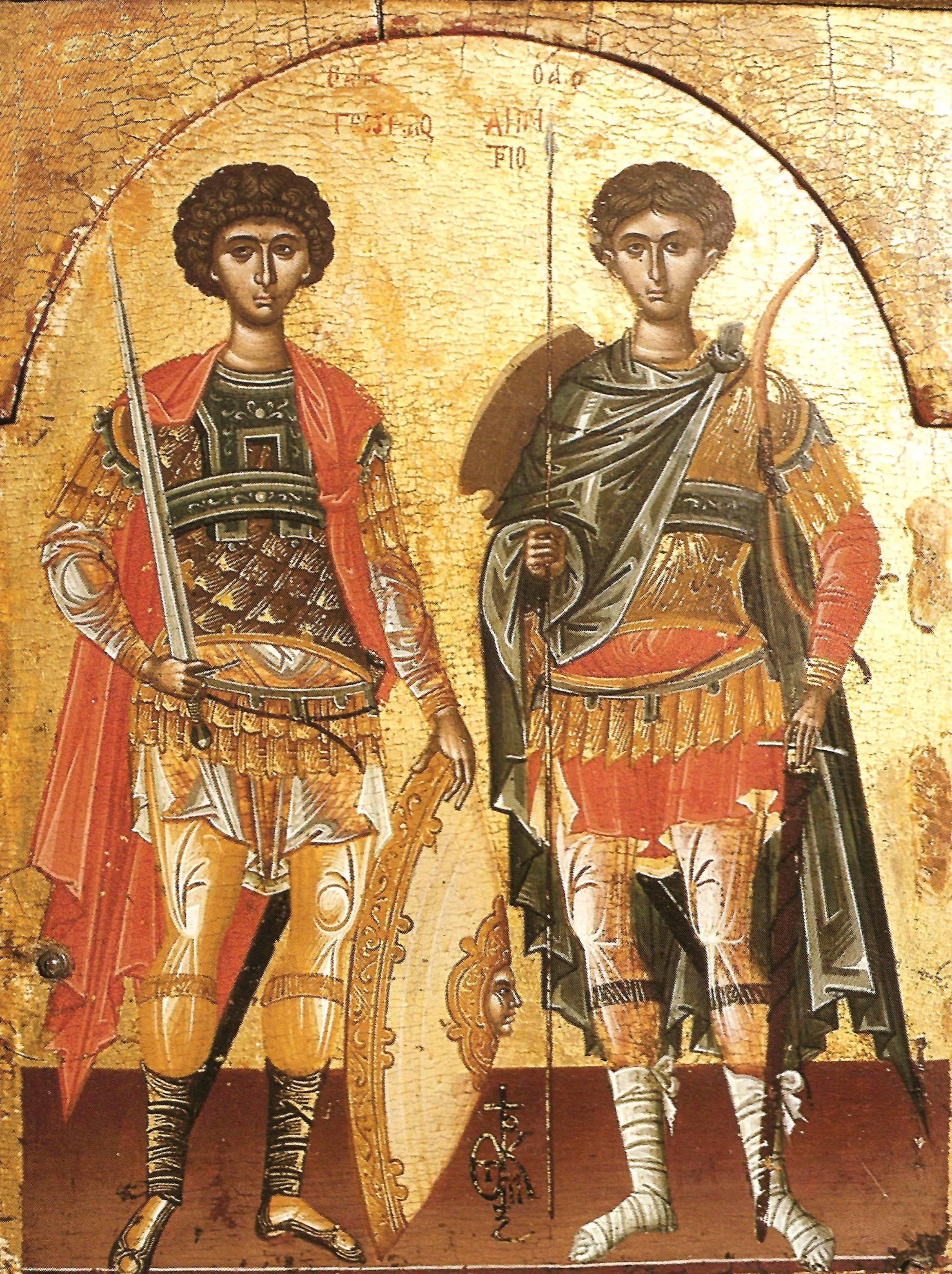
Sts George & Demetrios of Thessaloniki
Even though the population of Palestine is mainly Muslim today, Saint George was a Palestinian.
He is also the patron saint of several regions and cities, including Moscow, which is why there are so many Russian ikons of Saint George.
It is said that his cult was taken to England by crusaders returning from Palestine, and he became the patron saint of England. The English called on him for help in the battle of Agincourt, which was actually fought on Saint Crispin’s Day, but Saint George got the starring role, and in Shakespeare’s play Henry V the battlecry was “Cry God for Harry, England and St. George!” 
Shakespeare himself was born and died on Saint George’s Day, but he didn’t just make it up. After the battle Saint George’s Day, 23 April, was as important as Christmas in England.
The English are a bit ambivalent about Saint George now. His emblem of a red cross on a white ground is the basis of the flag of England, which over the last few years has become more popular in England than the Union Jack. Some bloggers have written about him today. St. Aidan to Abbey Manor: St. George? Here Be Dragons, I’m with Aidan.:
Theologian Ian Bradley called for St. Aidan to be made the new patron saint of England. Not just England, but the entire UK: He said: ‘St George had nothing to do with Britain and his legend was brought back here with the Crusades. St Andrew similarly had no links with Scotland and St Patrick was born in Scotland or England and put into slavery by the Irish. On the other hand, St Aidan unites three of the countries by having lived there and is, I believe, a better symbol for Britishness.
Others, of a more English nationalist turn of mind, think differently, like nourishing obscurity | What is wrong with England?:
HAPPY ST. GEORGE’S DAY, ENGLISH MEN AND WOMEN [PLUS BOYS AND GIRLS] ! Stephen Garnett, editor of This England magazine, said:
We’re incredibly disappointed that English people are afraid of displaying the St George’s Cross on our patron saint’s day. It was quite shocking to see some of the results, particularly the amount of people that don’t fly the flag because of fear of being judged. It just shows what political correctness has done to the English people over the years.
There are so many factors, not least being the concept of the Union Flag. One of the major reasons though is that we are now suffering the coming of age of a new generation of socialist miseducated children of ASBO susceptibilities, a process which really kicked in in the 70s, along with the disgruntled Gen X and its resentment of the Boomers plus the factor mentioned by Stephen Garnett – the debilitating PC pall which hangs over the land, embraced by so many.
Given the fairly recent history history of British imperialism and colonialism in many parts of Africa, it might seem to some that Saint George was a symbol and relic of colonialism. Many of the churches dedicated to him in Africa south of the Sahara were indeed built by English people, many of whom doubtless thought that they were planting a symbol of England on foreign soil.


But St George has been in Africa a long time, before England even existed. And he is just as much a symbol of anticolonialism as of colonialism, if not more so. Saint George is the patron saint of Ethiopia, and the Battle of Adwa, fought against the Italians in 1896, is as important for Ethiopians as the battle of Agincourt was for the English. And it was fought on the 1st of April, which is Saint George’s Day in Ethiopia.
The Scramble for Africa, which began in the mid-1880s, was led by the British and the French, and the Italians were late in coming to it. Virtually the only countries not already claimed by other European states were Ethiopia and Libya, and they set out to conquer those, and were repulsed.
The news that Ethiopia had defeated the Italians at the battle of Adwa in 1896 gave the Ethiopian movement in South Africa a tremendous boost. It showed that Europeans were not invincible, and for a while it boosted the popularity of the African Independent Churches (AICs) known as “Ethiopian”. For them, Ethiopian Christianity was a symbol of an African Christianity that was independent of Europe, and therefore independent of European colonialism. And so Saint George as patron saint of colonial powers like England is actually a pretty subversive symbol. He is just as much a symbol of anticolonialism, and so is perhaps a suitable symbol for a postcolonial age.
 
  Troparion – Tone 4 
The saint and his parents
You were bound for good deeds, O martyr of Christ: George;
by faith you conquered the torturer’s godlessness.
You were offered as a sacrifice pleasing to God;
thus you received the crown of victory.
Through your intercessions, forgiveness of sins is granted to all.
 
  Kontakion – Tone 4 
God raised you as his own gardener, O George,
for you have gathered for yourself the sheaves of virtue.
Having sown in tears, you now reap with joy;
you shed your blood in combat and won Christ as your crown.
Through your intercessions, forgiveness of sins is granted to all.
 
  The life of the saint
 
  The Holy Great Martyr George the Victory-Bearer, was a native of Cappadocia (a district in Asia Minor), and he grew up in a deeply believing Christian family. His father was martyred for Christ when George was still a child. His mother, owning lands in Palestine, moved there with her son and raised him in strict piety. When he became a man, St George entered into the service of the Roman army. He was handsome, brave and valiant in battle, and he came to the notice of the emperor Diocletian (284-305) and joined the imperial guard with the rank of comites, or military commander.
The pagan emperor, who did much for the restoration of Roman might, was clearly concerned with the danger presented to pagan civilization by the triumph of the Crucified Savior, and intensified his persecution against the Christians in the final years of his reign. Following the advice of the Senate at Nicomedia, Diocletian gave all his governors full freedom in their court proceedings against Christians, and he promised them his full support.
St George, when he heard the decision of the emperor, distributed all his wealth to the poor, freed his servants, and then appeared in the Senate. The brave soldier of Christ spoke out openly against the emperor’s designs. He confessed himself a Christian, and appealed to all to acknowledge Christ: “I am a servant of Christ, my God, and trusting in Him, I have come among you voluntarily, to bear witness concerning the Truth.”
For more, see here.


The tomb of Saint George in Lydda
 
See also
 
 
The historical Orthodox Church of St George in Cairo (from here

The historical Orthodox Church of St George in Tunis (from here). 
More about the Ancient Christianity (Orthodox Church) in Tunisia here.

Flag of the Greek Revolution of 1821 with St George and Prophet Elias (from here)
 

Ανακοίνωση: Το ιστολόγιό μας δεν έχει Facebook


Φωτο από εδώ

Φίλες μπλογκοναύτισσες, αγαπητές συνοδοιπόροι μας, που συμπλέουμε στον ωκεανό της μπλογκόσφαιρας, μας ενημέρωσαν - και τις ευχαριστούμε - πως κάποιος αδελφός έχει λογαριασμό στο Facebook με τίτλο "Νεκρός για τον κόσμο".
Προς αποφυγήν παρεξηγήσεων, ενημερώνουμε τους φίλους και τις φίλες της ταπεινής μας μπλογκονησίδας ότι δεν ξέρουμε ποιος είναι και ότι ο λογαριασμός αυτός δεν ανήκει στο ιστολόγιό μας. Μάλιστα δεν τον έχουμε δει ποτέ, ούτε ξέρουμε τι γράφει.
Το ιστολόγιό μας δεν έχει επεκταθεί στο Facebook και οποιαδήποτε πιθανή συνωνυμία είναι συμπτωματική.
Ευχαριστούμε.
ΧΡΙΣΤΟΣ ΑΝΕΣΤΗ!

Σάββατο 21 Απριλίου 2018

Ο Ιωσήφ, ο Νικόδημος και οι άρχοντες της κάθε εποχής (Κυριακή των Μυροφόρων)


ΕΥΧΗ
 
Ο Ιωσήφ ο ευσχήμων και δίκαιος είναι ένα πρόσωπο, που εμφανίζεται στα ευαγγέλια αμέσως την ημέρα του Πάθους και μετά τον θάνατο του Χριστού. Ζητά το σώμα από τον Πιλάτο και θάβει τον διδάσκαλό του, σε καινό μνημείο που προετοίμαζε για τον εαυτό του. 

Πληροφορούμαστε επίσης πως ήταν επίσημο πρόσωπο και πως περίμενε και αυτός την βασιλεία του Θεού, πράγμα που μπορεί να σημαίνει πως ήταν ένας κρυφός μαθητής του Χριστού, διά τον φόβο των Ιουδαίων, ή ένας πολύ ευλαβής και ευσεβής άνθρωπος.

Ο Νικόδημος είναι αυτός ο νυχτερινός μαθητής του Ιησού, με τον οποίο διαλέχτηκε κάποτε σε υψηλό θεολογικό επίπεδο και που προσπάθησε εις μάτην να υποστηρίξει τον Χριστό ενώπιον του συνεδρίου. Αυτός έφερε μια τεράστια ποσότητα μύρων στην ταφή του Χριστού για να τιμήσει τον διδάσκαλό του. 

Και οι δύο ήταν άνθρωποι της εξουσίας και με υπόληψη ενώπιον των ιουδαϊκών και ρωμαϊκών αρχών. Και όμως αυτή την τους την υπόληψη και κοινωνική θέση καταφέρνουν, από την αγάπη την πολλή ή από την καρδιακή τους εντιμότητα και με γενναιότητα ψυχής, να μην την υπολογίζουν. Ενώ ακόμα ο όχλος μαίνεται και οι άρχοντες της αμαρτίας επικρατούν και ο Ιησούς φαίνεται ότι νικάται και εξουθενώνεται και μαθητές και απόστολοι διασκορπίζονται και κρύβονται, τα δυο αυτά ιερά πρόσωπα δείχνουν γενναιότητα και αυτοθυσία. Περιστοιχίζουν τον ηττημένο και αποσυνάγωγο και εβδελυγμένον θεωρούμενον ως νεκρόν, ον απεδοκίμασαν οι θρησκευτικοί άρχοντες του λαού τους, και τον θάβουν επιμελώς και τιμητικά με βασιλικές τιμές.

Ζούμε σε μια εποχή που η εξουσία ταυτίζεται άμεσα με την πνευματική και υλική διαφθορά και η διαφθορά αυτή διαχέεται ως ατομισμός και δίψα για διάκριση, επιβίωση, αυτοπροβολή, συντήρηση του ειδώλου (Image) και στα κατώτερα κοινωνικά στρώματα. Όποιος δεν βαδίζει με τον συρμό και πολύ περισσότερο όποιος δεν αγωνίζεται να επιβληθεί εξουσιαστικά στο κοινωνικό στερέωμα, όχι μόνο καταποντίζεται, αλλά και αναγνωρίζεται ως περιθωριακός και μηδαμινός. Η στάση των ευσχημόνων ανδρών δεν είναι προκλητική μόνον για την εποχή τους. Είναι εκτός έθους και παραμένει προκλητική και για την σημερινή ανταγωνιστική και απόλυτα εικονολατρική εποχή.

Είναι πολύ γενναίο να πηγαίνεις ενάντια στο ρεύμα και στις κοινωνικές αρχές και συμβάσεις, είναι ανοίκειο να επιβάλεις εσύ το πρέπον επειδή υπάρχει προσωπική ηθική συνείδηση, ενώ γύρω και πλάι καταργείται κάθε γνήσια πρωτοβουλία και γνησιότητα. Ιερό είναι το επιβαλλόμενο και ό,τι επικρατεί. Λοιπόν, οι ευσεβείς είναι ασεβείς για τον κόσμο και οι φιλεύσπλαχνοι τρελοί που μαίνονται, άρα και οι έντιμοι είναι επικίνδυνοι και κάθε αλτρουισμος τρέφει την καχυποψία.

Ο νους μας δεν μπορεί να συλλάβει την παράσταση δύο αρχόντων να υπερβαίνουν τα νενομισμένα και να φέρονται με τέτοια ανθρώπινη τρυφερότητα και εντιμότητα σε έναν αποστάτη του γένους και της κοινωνίας. Γιατί οι άρχοντες είναι σκληροί συνήθως και υπηρετούν τον εαυτό τους. Ο Ιωσήφ και ο Νικόδημος είναι οι ήρωες της αγάπης και της αυτοθυσίας, αυτό που εμείς, που λεγόμαστε οι πολλοί και το σύνολον, έχουμε απαίτηση από την άρχουσα τάξη να ασπαστεί και να υποδυθεί: τον ρόλο της θυσίας και της προσφοράς, το σπάσιμο κάθε αλυσίδας που συγκρατεί την τυρανία του φόβου, της επιβολής και της διάκρισης.

Η φιλευσπλαχνία και η αγάπη για την αλήθεια, την έμπρακτη αλήθεια, είναι το αεί ζητούμενον. Φτάνει εμείς ως σύνολο να απεκδυθούμε την διαφθορά και την προκατάληψη και να εννοήσουμε πως οι άρχοντες δεν είναι οι ιεροφάντες του καθεστώτος και του πρέποντος και εμείς οι σιωπηλοί ακόλουθοί τους, αλλά οι τηρητές του αυτονόητου που έρχονται και να μας εκφράσουν, αλλά και να μας διδάξουν δίνοντας το παράδειγμα της γενναίας απόφασης. Σε κάθε άλλη περίπτωση αποτελούμε μαζί τους ένα αξιολύπητο σύνολο.


*****  
Κυριακή των Μυροφόρων, τρίτη Κυριακή από το Πάσχα

Των αγίων Μυροφόρων και των αγίων Νικοδήμου και Ιωσήφ από την Αριμαθαία, των «κρυφών μαθητών» του Κυρίου. 
 [Απόσπασμα από το αφιέρωμα: Από το Πάσχα ώς του Αγίου Πνεύματος]


Την Κυριακή αυτή (μετρώντας ως πρώτη την ίδια την Κυριακή του Πάσχα) η Εκκλησία τοποθέτησε την εορτή των αγίων μαθητριών του Κυρίου, που κατανίκησαν το φυσικό φόβο τους και ήρθαν χαράματα στον Πανάγιο Τάφο για να αλείψουν με μύρα (αρώματα) το σώμα Του, σύμφωνα με τα αρχαία ιουδαϊκά έθιμα. Όμως το μνημείο (ο Τάφος) ήταν άδειος, άγγελος Κυρίου τις ενημέρωσε ότι ο Κύριος αναστήθηκε και στη συνέχεια ο Ίδιος ο Κύριος τις συνάντησε και μίλησε μαζί τους – είναι η πρώτη εμφάνιση του αναστάντος Χριστού, που έκανε αυτή την τιμή στις γυναίκες, όχι στους άνδρες. Έκανε μάλιστα τις γυναίκες «ευαγγελίστριες» και αποστόλους των ανδρών, γιατί τις επιφόρτισε με την αποστολή να πληροφορήσουν τους μαθητές Του το γεγονός της ανάστασης. Για τις εμφανίσεις του Κυρίου μετά την ανάστασή του, δείτε το παρακάτω άρθρο: Πόσες και ποιες εμφανίσεις του Αναστάντος Χριστού έχουμε και πότε έγιναν;.

Κατά τους Πατέρες της Εκκλησίας, Μυροφόρος ήταν και η Θεοτόκος (είναι η «άλλη Μαρία» του Ευαγγελίου ή η «Μαρία Ιακώβου»). Γι’ αυτό στην εικόνα της συνάντησης των Μυροφόρων με τον Κύριο πάντοτε απεικονίζεται και εκείνη. Αναλυτικά εδώ.

Την ίδια μέρα τιμάται η μνήμη των δύο Ιουδαίων αξιωματούχων που αποκαθήλωσαν τον Κύριο από το σταυρό (αφού ζήτησαν το Σώμα Του από τον Πιλάτο) και ανέλαβαν την ταφή Του. Είναι οι άγιοι Νικόδημος και Ιωσήφ από την Αριμαθαία. Ο άγιος Νικόδημος εμφανίστηκε μια νύχτα και συνομίλησε με τον Κύριο και, όταν το Ιουδαϊκό Συνέδριο συνωμοτούσε για να Τον σκοτώσει, προσπάθησε να Τον υπερασπιστεί, αλλά χωρίς επιτυχία (κατά Ιωάννην, κεφ. 3, και 7, 50-52).

Ο άγιος Ιωσήφ, κατά την παράδοση, κήρυξε το Ευαγγέλιο μέχρι τη Βρετανία και είναι ένας από τους αποστόλους των Βρετανών, μαζί με τον άγιο Αριστόβουλο, έναν από τους 70 Αποστόλους. 


Περισσότερα για την Κυριακή των Μυροφόρων εδώ.
 
Επισκεφθείτε επίσης:

Οι Μυροφόρες δεν πίστευαν… αλλά πήγαν!

Των Μυροφόρων: Σήμερα διαλαλούμε σε όλους τους άνδρες ότι ο Χριστός Ανέστη! Σήμερα θα έπρεπε να εορτάζεται η Γιορτή της Γυναίκας (εικ.) 

Δεν καταλαβαίνω αυτά που λέγονται στην Εκκλησία...
 
The Sundays after Easter in the Orthodox Christian Heritage!  


"True freedom is to choose the better in the light of truth..."


Death to the World (About)


Some people by the word freedom understand the ability to do whatever one wants... People who have the more allowed themselves to come into slavery to sins, passions, and defilements more often than others appear as zealots of external freedom, wanting to broaden the laws as much as possible. But such a man uses external freedom only to more severely burden himself with inner slavery.
True freedom is the active ability of a man who is not enslaved to sin, who is not pricked by a condemning conscience, to choose the better in the light of God's truth, and to bring it into actuality with the help of the gracious power of God. This is the freedom of which neither heaven nor earth are restrict.

+St. Philaret of Moscow


From here: "...For the Christians are distinguished from other men neither by country, nor language, nor the customs which they observe. For they neither inhabit cities of their own, nor employ a peculiar form of speech, nor lead a life which is marked out by any singularity... They dwell in their own countries, but simply as sojourners. As citizens, they share in all things with others, and yet endure all things as if foreigners. Every foreign land is to them as their native country, and every land of their birth as a land of strangers... They pass their days on earth, but they are citizens of heaven."

-Epistle to Diognetus 5, discussing the behavior of Christians. The only tribe we belong to, is the heavenly one. Beware of those who teach otherwise.


Kenya (from here & here)
See also

About Richard-Spyros Hagabimana, an Orthodox Christian of Burundi
Orthodox Mission in Tropical Africa (& the Decolonization of Africa)

Miley Cyrus, or: why Orthodox Mission in the West is an urgent need... 

Why I’m not an atheist
Punks to Monks: Effects of the Last True Rebellion (Video)
False Black: Gothic Orthodox?


A Letter from an Orthodox Christian to our Native Americans Brothers

VALERIU GAFENCU - The Saint of the Prisons and Prisoners
Through Closed Doors
"THE WAY" - An Introduction to the Orthodox Faith
Theosis (deification): The True Purpose of Human Life
The holy anarchists... in the Egyptian Desert